

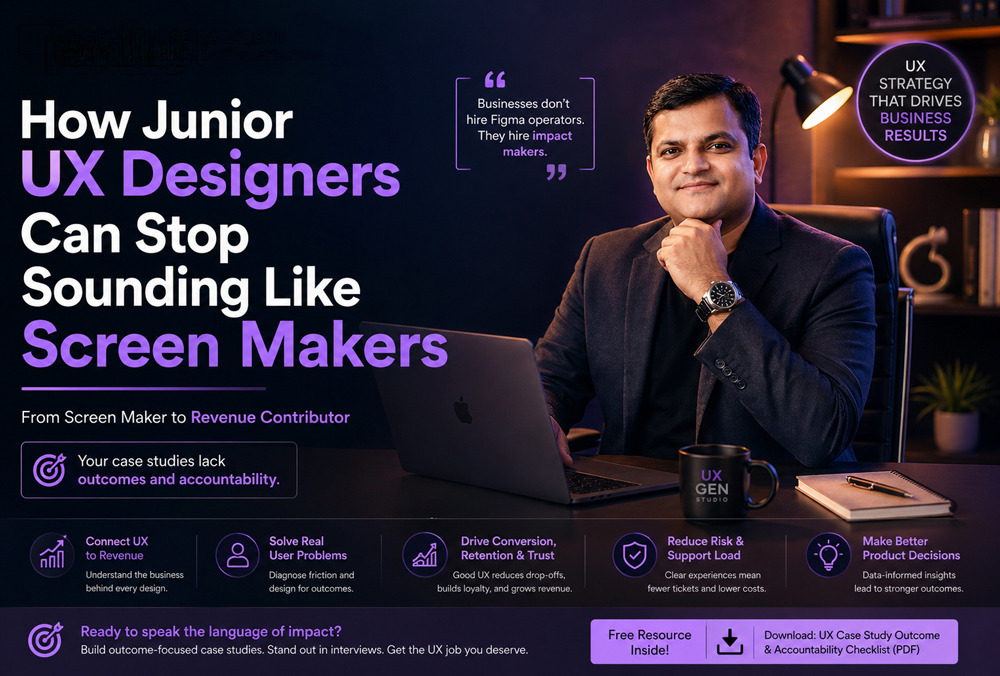
To land a high-paying ux job, stop listing design deliverables. Top companies do not hire Figma operators; they hire problem solvers who reduce friction, drive conversions, and protect the bottom line.
If you are stuck facing an experienced ux no job offer reality, it is because your case studies lack outcomes and accountability. Shift your focus from visual output to business impact, navigate complex trade-offs, and prove how your design decisions influence revenue, retention, and risk reduction.
The fastest way to guarantee a rejection from a top corporate company is to sit in an interview and list your deliverables. You might proudly state that you made wireframes, created user flows, designed high-fidelity screens, and used Figma components.
That is not wrong. But it is incredibly weak.
I have spent over 20 years as a UX Architect, Usability Analyst, and CRO Expert diagnosing complex friction points for enterprise clients. Let me give you the hard truth: Businesses do not pay premium salaries to people who only produce screens.
They hire revenue contributors.
The real problem keeping you stuck is simple. Your case studies lack outcomes and accountability. When your portfolio sounds like a task list, hiring managers see a junior order-taker, not a strategic partner.
If you are applying endlessly, getting interviews, but still facing the painful loop of experienced ux no job offer, this guide is your blueprint to pivot.
Why Businesses Reject “Figma Operators”
Most junior designers think rejection happens because their UI is not beautiful enough. In corporate interviews, visual design is rarely the dealbreaker. The issue is weak thinking.
A hiring manager or CEO is silently evaluating you on business survival skills. They want to know if you can understand business pressure and logically explain the why behind your design decisions.
They need to see if you can handle technical and timeline constraints without breaking the user experience. They are looking for someone who can connect UX work to financial outcomes and reduce risk for the engineering team.
If your answer in an interview is simply, “I redesigned the homepage to make it clean and modern,” you sound exactly like a screen maker.
If your answer is, “The homepage had competing CTAs causing decision friction, so I simplified the hierarchy and moved trust signals closer to the primary action to improve clarity for buyers,” you sound like an executive-grade UX professional.
Screen Maker vs. UX Strategist: The Difference
You do not stop sounding junior by using fancy words. You do it by showing better thinking. Here is the exact shift you need to make in your vocabulary.
| The Screen Maker Language (Output) | The UX Strategist Language (Outcome) |
| “I designed 12 screens.” | “I improved the task flow across 12 critical decision points.” |
| “I made the UI clean and modern.” | “I reduced visual noise so users could identify the primary action faster.” |
| “I created an analytics dashboard.” | “I helped users monitor the exact metrics that influence their business decisions.” |
| “I improved the page layout.” | “I restructured the information hierarchy to reduce cognitive load and friction.” |
| “I added a CTA button.” | “I repositioned the CTA based on user intent and conversion priority.” |
| “I made a clickable prototype.” | “I tested interaction assumptions to mitigate risk before development investment.” |
The True Business Value of Design
A screen is only valuable when it fundamentally changes user behavior. A beautiful checkout screen that does not improve completion rates is not a business asset.
Similarly, a smooth onboarding flow that looks great but does not reduce day-one drop-offs is just digital decoration.
Leading industry research, including data from McKinsey, shows that companies treating design as a core business driver grow revenue at nearly twice the rate of their peers. The Nielsen Norman Group also consistently reports that usability redesigns act as powerful performance levers.
UX is a growth engine. Your portfolio must answer one critical question: What changed because of your design decision?
he Portfolio Problem: Your Case Studies Are Incomplete
Let’s audit your portfolio right now. If your UX case study only relies on a problem statement, user personas, empathy maps, wireframes, and UI screens, it is deeply incomplete.
These are activities. These are not business outcomes.
A highly-converting UX case study must act as a compelling business narrative. It needs to explain the exact business problem and the evidence you used to validate it, whether through heuristic evaluations, analytics, or user feedback.
You must also highlight the engineering or budget constraints you navigated. Finally, you need to clearly state the strategic UX decision you made and the tangible impact it had after going live.
If you do not have live analytics, you still need to show directional impact and accountability.
For example, you can talk about how you reduced checkout steps from seven to four. You might mention removing duplicate form fields to lower cognitive friction, or improving CTA clarity based on heat mapping assumptions to reduce support tickets.
The 3 Layers of Executive UX Thinking
A junior designer asks, “How should this screen look?” A senior strategist asks, “What user behavior must change for the business outcome to improve?”
Every elite UX project operates on three distinct layers. If you only talk about the first layer, you will stay stuck in the junior trap.
The User Layer
This is where you ask what the user is trying to accomplish. You look for the cognitive friction and identify where the user journey breaks down.
The Business Layer
This means understanding what the company needs the user to complete, buy, or adopt. You must evaluate how a specific screen impacts revenue, user activation, or long-term retention.
The Risk Layer
You have to design for risk mitigation. Ask yourself what happens to the business if the experience fails, or how much expensive engineering time is wasted if you build the wrong feature.
When you map your design decisions to Revenue, Conversion, Retention, Support Load, and Risk Reduction, the power dynamic in your interviews changes instantly.
How to Rewrite Your Portfolio Like a Revenue Contributor
Use this direct before-and-after framework to rewrite your case studies today.
Scenario 1: The Checkout Flow
Instead of saying, “The checkout flow was confusing, so I redesigned it,” elevate your language. Say, “The checkout flow had an unclear payment hierarchy and weak trust signals, creating hesitation. I consolidated the steps and anchored trust badges near the final payment action.”
Scenario 2: The Onboarding Experience
Instead of saying, “I redesigned the onboarding to be more user-friendly,” focus on the cognitive load. Say, “New users were facing cognitive overload before completing their first meaningful action. I redesigned the flow using progressive disclosure, allowing users to reach platform value faster.”
Scenario 3: The B2B Dashboard
Instead of saying, “I made a dashboard for the users,” talk about data clarity. Say, “The legacy dashboard displayed data but lacked actionable insights. I reorganized the layout around priority metrics, risk alerts, and next-best actions to speed up user decision-making.”
The Executive Interview Formula: Stop Listing Tools
When an interviewer asks you to walk them through a project, never start with the software tools you used. Use a structured framework to control the room and demonstrate your executive mindset.
Context and Problem
Start by setting the specific product and business situation. Then, clearly define what was fundamentally broken in the user experience that caused a business bottleneck.
Evidence and Decision
Explain how you validated this problem using heuristics, data, or research. Following that, present the strategic UX decision you made to fix the core issue.
Trade-offs and Outcomes
Discuss what feature you deliberately chose not to build due to time or technical constraints. Finally, share what improved, or detail the specific metrics you would monitor if the product went live.
The Framework in Action
“The primary problem wasn’t the visual design; it was decision overload. Users had too many subscription plan options with unclear feature differences. I simplified the comparison architecture and highlighted the highest-margin plan. If this were live, I would measure the plan-selection rate and track support queries related to pricing confusion.”
How UXGen Academy Bridges the Gap
At UXGen Academy, our goal is not to create more tool-dependent designers. Our mission is to build premium UX practitioners who understand how design functions inside a high-stakes business environment.
This is exactly why we built the AI Driven UX Launchpad.
We designed our curriculum to be ruthlessly career-oriented. Through the Launchpad, students learn to think far beyond UI screens and build case studies heavily anchored in outcomes and accountability.
You will learn how to defend your design decisions in executive interviews and push back against bad product requirements. More importantly, we teach you how to connect usability directly to revenue, trust, and retention.
As Mentor Manoj, I bring over 25 years of field experience as a UX Researcher, UX Architect, and hiring practitioner into this program. The Launchpad isn’t about teaching you outdated theory; it’s about deploying decades of insider hiring knowledge to make you undeniably employable.
We teach you how to leverage AI to diagnose friction faster and articulate your business value so clearly that companies cannot afford to ignore you.
👉 Download the UX Case Study Checklist Here
DM “UX Launchpad” on my social channels if you want structured, elite guidance on building a job-ready UX portfolio.
FAQ: How Junior UX Designers Can Land Premium Jobs
- Why am I not getting a UX job even after mastering Figma?
Companies do not hire strictly for Figma skills because Figma is just a hammer. A premium ux job requires problem-solving, cognitive psychology, business acumen, and the ability to articulate how your design decisions impact the company’s bottom line.
- What does the “experienced ux no job offer” cycle actually mean?
It typically means you have enough experience to get your foot in the door, but your portfolio fails to prove impact. Hiring managers are seeing your deliverables but are missing your strategic trade-offs or business accountability.
- What must junior UX designers include in their case studies to stand out?
Beyond basic wireframes, you must include the business context and specific heuristic research insights. You also need to show the strategic design decision, the technical trade-offs you navigated, and the expected or measured business outcome.
- How can I show UX impact if I do not have real company analytics?
You must rely on directional impact and proxy metrics. Highlight how you reduced task steps, removed unnecessary form fields, created a clearer information architecture, or sped up completion times during qualitative usability testing.
- How do I stop sounding like a beginner in UX interviews?
Stop listing the software tools you used to build a screen. Start your answers by explaining the business problem, the user behavior you targeted, the constraints you worked within, and the exact metric your design was intended to influence.
- Is a strong UI design enough to get a UX job in today’s market?
No. While a clean UI is a baseline expectation, AI can generate UI components rapidly today. Companies want designers who understand complex task flows, conversion rate optimization (CRO), user retention, and enterprise-level usability.
- How does the AI Driven UX Launchpad by UXGen Academy help me get hired?
The AI Driven UX Launchpad shifts your mindset from “screen maker” to “revenue contributor.” Leveraging Mentor Manoj’s 25+ years of industry experience, it provides a strictly career-focused curriculum that teaches you how to build outcome-driven case studies and dominate UX interviews.


