

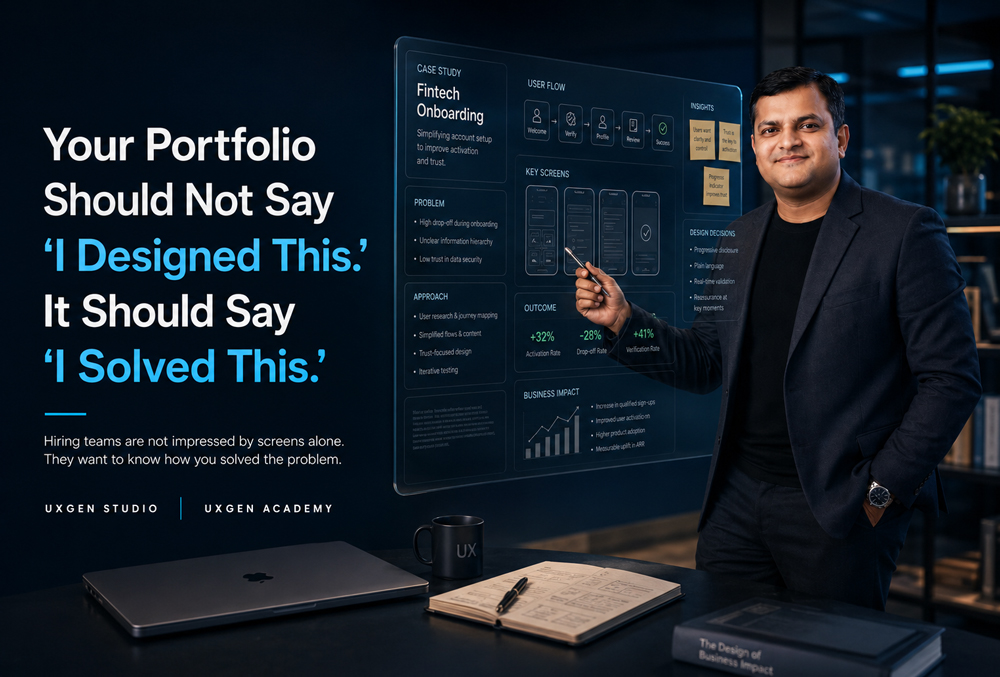
A strong portfolio does not help you get a ux job simply because it has beautiful screens. It helps when it proves one thing clearly: you can understand a messy problem, make smart decisions, and improve something that matters to the business.
Hiring teams at enterprise and SaaS companies are not buying your Figma file. They are evaluating your thinking.
When executives review your portfolio, they want to know:
- What was broken?
- How did you diagnose it?
- What trade-offs did you handle?
- Did your work create value for users and the business?
This is where many junior UX/UI designers with 6 to 24 months of experience get stuck. You have portfolios. You have screens. You have redesigns. Still, you get ignored.
Why? Because your case studies lack outcomes and accountability. In today’s UX market, that is a serious problem. Industry leaders like the Nielsen Norman Group have repeatedly emphasized that portfolios must show the entire design process and the rationale behind it, not just polished final artifacts.
The Real Problem: You Are Showing Output, Not Judgment
Most junior portfolios sound exactly like this:
- “I designed a mobile app for food delivery.”
- “I created a dashboard UI.”
- “I redesigned the checkout flow.”
This tells me what you made. It does not tell me whether you can think. A hiring manager doesn’t sit there thinking, “Wow, nice card design.” They are thinking about risk. Can this person handle ambiguous requirements? Can they connect UX decisions to business goals? Can they reduce friction, or do they just decorate screens?
If you are searching for answers to why you are an experienced ux no job offer statistic, the issue is rarely your visual talent. It is your storytelling. You are presenting yourself as a UI executor, not a UX problem-solver.
The “Aesthetics vs. Analytics” Trap
Look, I appreciate a premium aesthetic as much as anyone. I love a clean, dark mode interface with deep slate backgrounds, subtle indigo accents, and crisp glassmorphism. It looks professional. It feels expensive.
But here is the hard truth I have learned from consulting with enterprise clients: a beautiful UI cannot save a broken user flow.
If you spend three weeks perfecting the border radius on your buttons, but completely ignore that your multi-step form violates the Zeigarnik Effect and causes a massive user drop-off, the business is still losing money.
CEOs and Product VPs don’t care about your drop shadows. They care about Customer Acquisition Cost (CAC), Net Revenue Retention (NRR), and Revenue Per Visitor (RPV). When you prioritize visual aesthetics over business-centric analytics, you trap yourself in the “junior designer” box. You must start framing your design choices around how they move the needle for the business.
Screen-First vs. Outcome-First Portfolios
Let’s look at exactly how a junior mindset compares to an executive-grade mindset on a portfolio level. Hiring managers scan for these differences instantly.
| Portfolio Element | The “Screen-First” Mindset (Junior) | The “Outcome-First” Mindset (Executive) |
|---|---|---|
| The Hook | “I wanted to redesign this app to look modern.” | “The platform had a 40% drop-off at pricing, inflating CAC.” |
| The Process | Generic steps: Personas, Journey Maps, Wireframes. | Targeted diagnosis: Heuristic evaluation, identifying cognitive load. |
| The Design | Showcasing final, pixel-perfect mockups with no context. | Explaining why elements were placed there (e.g., Fitts’s Law). |
| The Challenges | “Choosing the right color palette was hard.” | “We had to scale back the feature due to strict API constraints.” |
| The Results | “Users loved the new design.” | “Reduced support tickets by 15% and increased task clarity.” |
The left column shows execution. The right column shows problem-solving. UX impacts conversion, retention, trust, support load, and decision clarity. When you fix a broken checkout flow, you aren’t just designing—you are driving business growth.
Navigating the Messy Reality of Enterprise SaaS
Another reason portfolios fail is that they look too perfect.
Real product development is incredibly messy. It is full of legacy code, tight deadlines, stubborn stakeholders, and shifting requirements. If your case study looks like a perfect, uninterrupted straight line from “Idea” to “Beautiful Figma Prototype,” I know you haven’t really been in the trenches.
Hiring managers want to see how you handle ambiguity. Did you have to compromise on your ideal UX because the engineering team said it would take three months to build? Did you have to launch a less-than-perfect MVP to meet a Q3 deadline?
Talk about these trade-offs! Documenting what you didn’t do, and why, shows immense maturity. It tells me you understand how to balance user needs with harsh business realities.
The Executive Case Study Framework
Stop treating your case studies like a diary entry. Use this streamlined structure to build a narrative that hiring panels actually want to read.
- Start With the Business Problem
Do not open with mockups. Open with context.
- Don’t write: “The onboarding screens looked outdated.”
- Do write: “The onboarding flow had a high drop-off because users didn’t understand the next step, inflating our Customer Acquisition Cost (CAC).”
- Define the User Friction
Explain exactly what users were struggling with to show your diagnostic ability. Were users confused by too many choices? Did they lack trust in the pricing page? Define the exact cognitive load or heuristic failure.
- Show Your Investigation and Trade-offs
Write what you actually did and the constraints you faced. Did you map decision points? Did you conduct a heuristic evaluation? What features did you cut due to technical constraints?
- Connect to Outcomes
If you have real numbers, use them. If it was a concept project, be honest and accountable: “Success was measured through usability feedback, task clarity, and friction reduction assumptions.”
Bridging the Gap with Real Expertise
At UXGen Academy, we do not train learners to just create attractive UI screens. That is simply not enough for the current market.
Our curriculum is ruthlessly career-oriented. We help career switchers and early-stage designers understand how real UX work connects with business goals like Net Revenue Retention (NRR) and ROI.
This is the core of our AI Driven UX Launchpad. As the CTO and Co-founder, I ensure our technology and strategy frameworks are built for the modern SaaS landscape. But the real powerhouse of the Launchpad is Mentor Manoj. He is a seasoned UX researcher and design leader with over 25 years of experience. As a hiring geek who has seen every portfolio mistake in the book, his role isn’t just to teach tools. He deploys his total industry experience to help you understand what the market actually expects, how to diagnose product friction, and how to present your work like a premier problem-solver.
You don’t need more motivation or generic bootcamps. You need structure, practical thinking, and job-focused execution.
Audit Your Portfolio Today
Stop sending out case studies that fail to show your true value. Before you apply for your next role, evaluate your work against the metrics hiring managers actually care about.
👉 Download: UX Portfolio Scoring Rubric What Hiring Panels Score
Use this rubric to grade your own portfolio. It will help you identify exactly where your storytelling falls flat, where you are missing business metrics, and how to rewrite your case studies to attract premium enterprise leads.
Frequently Asked Questions (FAQ)
- How do I get a UX job with no formal experience?
Focus on creating real-world value. Instead of unsolicited, superficial redesigns of massive brands like Apple, find a local B2B business or a small SaaS startup. Solve one specific usability problem that impacts their revenue, and document your diagnostic process clearly.
- Why am I getting rejected if my UI design is excellent?
Because companies do not hire UX designers purely for visual output; they hire them to reduce business risk. If your portfolio looks beautiful but fails to explain the why behind your decisions or the business metrics you aimed to improve, hiring managers will pass.
- What if my project didn’t launch and I have no real metrics?
Accountability matters more than perfect data. State clearly that it was a concept or unlaunched project. Then, explain your expected outcomes based on usability testing, friction reduction, and task completion rates.
- How long should a UX case study be?
It should take no more than 3 to 5 minutes to read. Hiring managers scan portfolios. Use short paragraphs, clear headings, and bullet points. Focus on creating “dwell time” through unique insights and honest trade-offs, rather than writing a textbook about your process.
- What is the most important part of a UX case study?
The diagnosis and the trade-offs. Showing the final design is easy. Explaining how you identified the friction, why you discarded alternative solutions, and how you navigated constraints is what proves you are an executive-grade designer.


