

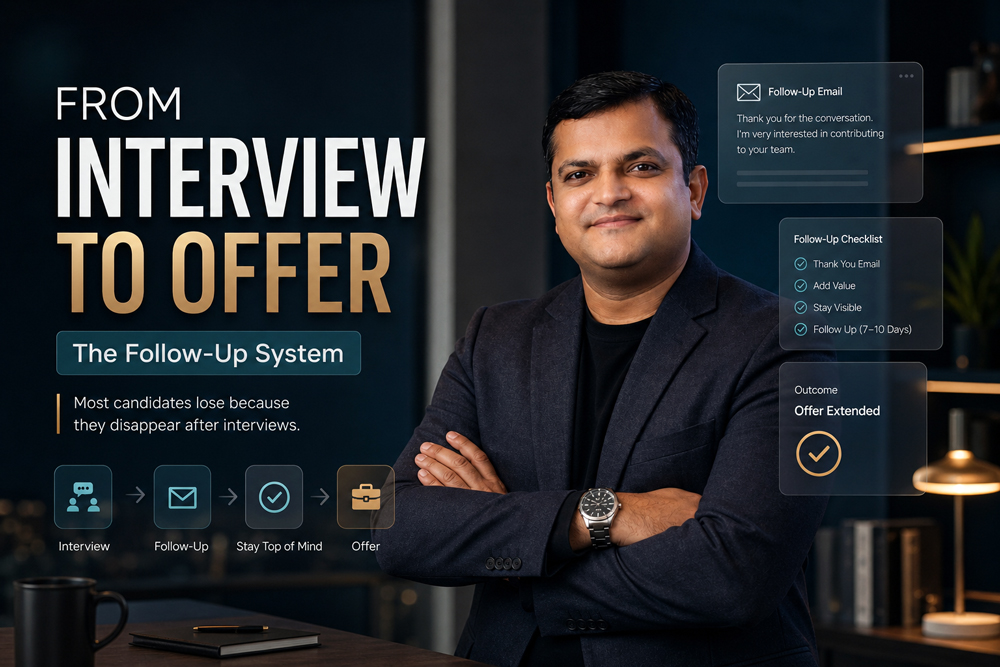
The Executive Follow-Up Strategy
To land a premium UX job, you cannot just wait by the phone. The best candidates treat the interview as a kickoff meeting. Within 24 hours, send a strategic follow-up email that shifts the focus from your design skills to their business problems. Outline a micro-teardown of a friction point you discussed, map it to potential revenue or retention metrics, and show you are a partner, not just a screen-maker.
The Silent Killer of Your UX Career
I have been in this industry for a long time, building scalable solutions for enterprise and SaaS clients. Do you want to know a hard truth about hiring?
Most candidates do not lose the UX job because they are untalented. They lose because they disappear after the interview. They answer the questions, walk through their slides, say thank you, and then they wait.
No follow-up. No proof of thinking. No business clarity.
In a competitive UX hiring process, silence is not neutral. Silence makes you forgettable.
For junior UX/UI designers with 6–24 months of experience, this is a serious problem. You might have decent UI skills and a solid portfolio. You might even answer interview questions reasonably well. But if you are living the experienced ux no job offer reality, there is a harsh truth you need to face:
Your case studies lack outcomes and accountability.
When your portfolio only shows that you “made things look modern,” hiring teams will hesitate. A UX interview is not just a conversation about typography; it is a trust evaluation. The follow-up is where you prove that you think like a product designer, not just a screen designer.
Why UX Candidates Disappear
Most candidates think, “If they liked me, they will call.” This mindset is dangerous.
Hiring teams are busy. Multiple people are involved, and the final decision often depends on small signals. Your follow-up is a decision-support artifact. It helps them remember what problem you can solve, how clearly you think, and why you are lower risk than the next candidate.
For a junior designer, your follow-up becomes evidence of maturity. It is not about begging for an update. A strong follow-up says: “I understood the business problem. I reflected on the discussion. Here is the additional clarity I can bring.”
The Real Problem: How You Sell Your Work
Let’s be direct. You get the first call, maybe the second, but you never get the offer letter. Why? Because you are selling them on how things look, while they are trying to buy solutions for how things work.
Many junior designers fail because their narrative sounds like this: “I redesigned the app to make it more user-friendly.”
That sentence does nothing for a business leader. User-friendly for whom? Which friction did you reduce? What was the business risk? What changed after your intervention?
This is why your case studies lack outcomes and accountability. And when that happens, the interviewer might like your visuals but still doubt your professional readiness to handle actual business metrics.
The Portfolio Signal Shift:
- Weak Signal: “I improved the UI.”
- Strong Signal: “I reduced decision friction in the onboarding flow, which was causing a 15% drop-off rate.”
- Weak Signal: “I made it modern.”
- Strong Signal: “I improved trust signals, reduced cognitive load, and clarified the primary CTA path.”
The 3-Layer Follow-Up System
A strong follow-up should not be a generic thank-you email. It needs to reconnect your skills to the company’s problem and add missing clarity. Use this system after every serious UX interview.
Layer 1: The Same-Day Recall
Send this within 24 hours. The goal is not to impress with length, but to create a business-level memory.
Subject: Thank you for the conversation
Hi [Name],
Thank you for taking the time to speak with me today.
I especially liked our discussion around [specific product/business problem]. It gave me a clearer view of how the team thinks about user experience and business goals.
One thing I wanted to reinforce is that my strength is not only creating screens, but understanding where users face friction and how design decisions can improve task completion and trust.
I would be excited to contribute to this role.
Regards, [Your Name]
Layer 2: The Value-Add (The Dwell Time Creator)
Send this if the interview included a deep dive into a product problem. This is where most UX candidates do nothing, which is your advantage. Send a short note with one useful insight, or a micro-teardown of a friction point you discussed.
For example, mention that you revisited the onboarding flow discussed during the interview. Note that the first decision point appears too early, increasing hesitation. Suggest that if you were working on this, you would validate it through a quick task-based usability test.
This shows reflection, product thinking, and business awareness. You are not saying their product is bad; you are saying you understand how friction affects user decisions. That is executive-grade UX thinking.
Layer 3: The Waiting-Period Follow-Up
If they gave you a timeline, respect it. If they said, “We will update you next week,” follow up after that week passes. Keep it incredibly short. Mention you remain interested because the role connects closely with the specific business challenge you discussed earlier.
The Follow-Up Scorecard
Before you hit send on any post-interview email, run it through this quick scorecard:
- Did I mention a specific discussion point?
- Did I connect my skill to a business or user problem?
- Did I avoid sounding desperate?
- Did I add clarity beyond a simple “thank you”?
If your email is vague, your design thinking will also look vague. Your communication is part of the product experience you are selling.
Upgrading Your UX Career Trajectory
At UXGen Academy, we do not train learners only to create screens. That is simply not enough anymore. A junior UX designer needs to understand how business goals connect with UX decisions and how to present case studies with actual outcomes.
This is exactly why we built the AI Driven UX Launchpad. It is a career and job-oriented learning system. We are not interested in outdated theory or random tool practice. Mentor Manoj brings over 25 years of experience as a UX researcher and hiring geek into this curriculum. His role is to help you understand how UX works in real business environments.
Many candidates know Figma, but they cannot explain friction. They have UI screens, but they cannot defend their design decisions in a boardroom. UX Launchpad helps learners, career switchers, and stuck professionals build that missing professional layer, so you can move from “I designed this” to “I solved this business problem.”
Your Next Step
The offer is not won only in the interview. It continues through your follow-up. Most candidates disappear. Premium candidates create trust after the call ends.
If you are facing the experienced ux no job offer problem, do not just blame the market. Audit your follow-up system.
Download PDF: “UX Interview Follow-Up System: Email Templates & Case Study Outcome Checklist”
Want to stop sounding like every other UX candidate? Download my free guide to get the exact same-day follow-up templates, interview reflection worksheets, and the case study accountability scorecard.
DM UX Launchpad to get the follow-up checklist and understand how to present your UX work with stronger career positioning.
Frequently Asked Questions (FAQ)
- How soon should I follow up after a UX job interview?
You should send your first strategic follow-up email within 12 to 24 hours. This keeps you fresh in the hiring manager’s mind and shows immediate proactivity and professionalism.
- Why am I getting interviews but no UX job offer?
If you have experience but no offers, you are likely failing to prove business value. Your case studies lack outcomes and accountability. You must shift your narrative from “what I designed” to “how this design impacted the business metrics like conversion or retention.”
- What should a junior UX designer write after an interview?
Avoid generic thank-you lines. Write a follow-up that shows listening and product thinking. Mention one specific business problem discussed during the interview and reinforce how your UX approach can reduce friction regarding that specific issue.
- Should I send my portfolio again after the interview?
Only if it adds direct value. You can send a link to a specific case study if it directly supports a challenge or topic you discussed during the interview, rather than just sending the general homepage again.
- How many times should I follow up after a UX interview?
Usually, one value-driven thank-you message and one timeline-based follow-up are sufficient. Professional follow-up should create confidence in your abilities, not pressure on the hiring team.


