

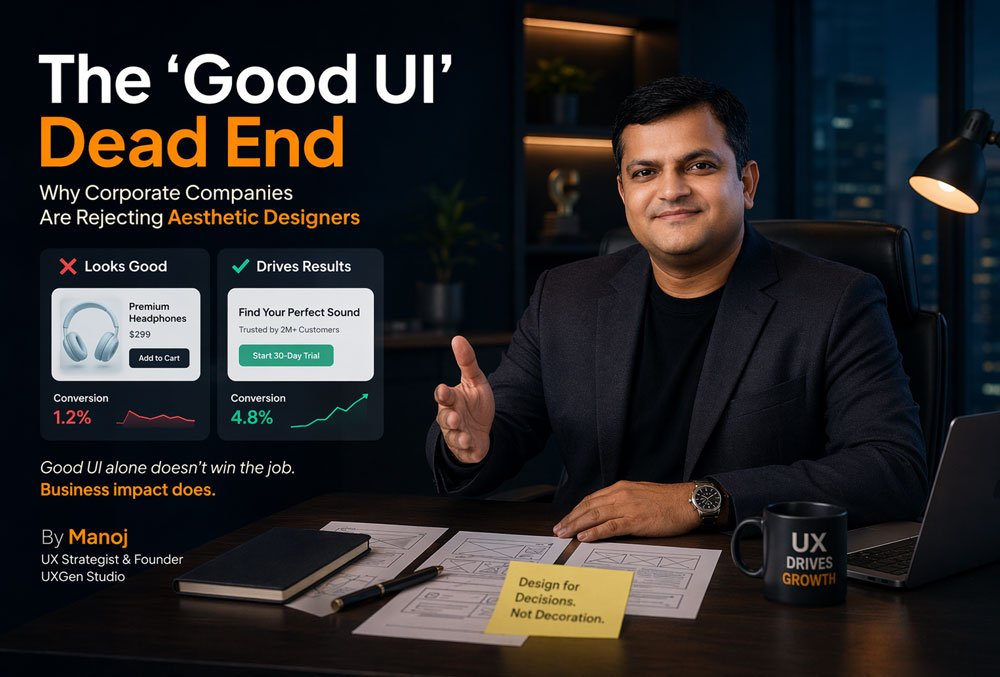
A polished screen is no longer enough to win a serious ux job. Corporate hiring teams are not rejecting visual skill; they are rejecting portfolios that fail to prove business thinking, trade-off awareness, and measurable impact. If you are stuck in the “experienced ux no job offer” loop, it is because your case studies lack outcomes and accountability. To get hired, you must transition from a visual decorator to a strategic, business-first UX architect.
Here is the uncomfortable truth. A pixel-perfect interface proves you know how to use a tool. It does not prove you know how to reduce friction, improve activation, increase retention, lower support dependency, or protect trust.
That is why many designers with aesthetically pleasing portfolios are stuck. They are still selling screens to people who are buying outcomes. And that is exactly why so many designers quietly search for things like “experienced ux no job offer” while wondering what went wrong.
In many cases, the answer is brutally simple: Your case studies lack outcomes and accountability. Recent guidance from the Nielsen Norman Group (NN/g) points out that hiring managers want to see the problem, the process, the constraints, and the value created for both users and the organization. Furthermore, the hiring climate has shifted back toward employers. Candidates are often first evaluated by recruiters, product managers, or founders rather than fellow designers. That entirely changes what “good” looks like in a portfolio.
Corporate Companies Are Rejecting Visual-Only Thinking
Let’s make this precise. Companies still care about aesthetics. Good visual design improves perception, clarity, and trust. But aesthetics without business logic feels expensive. It feels risky. It feels junior.
NN/g recently explained the aesthetic-usability effect: users often perceive attractive products as easier to use than they really are. That sounds like a win, but only for a while. A pretty interface can hide minor problems, but it cannot rescue major friction, task failure, bad navigation, or broken workflows.
When a hiring manager looks at your shiny screens, they might acknowledge your visual taste, but their immediate internal questions are far more critical: Can this person handle ambiguity? Can they work with constraints? Can they defend trade-offs? Can they improve a metric that the business actually tracks?
If your portfolio does not answer those questions fast, you do not look strategic. You look decorative.
The Three Reasons Your UX Job Search Is Stuck
Most struggling portfolios fail in one of three specific ways.
1. Showing the Final Screen, Not the Commercial Problem
NN/g’s portfolio research confirms that hiring teams want to know how you moved from an opportunity to real value. They do not just want the shiny end result; they want the messy middle. A beautiful mobile banking dashboard is not the story. The real story is that users were dropping off during onboarding, support tickets were rising around identity verification, and your redesign reduced confusion and improved completion rates. That is a business story.
2. Confusing Redesign Theater with Real UX Work
This one hurts, but it needs to be said. Hypothetical redesigns and polished exercises on platforms like Dribbble or Behance do not create persuasive portfolio material. Real work includes technology limits, skeptical stakeholders, and actual user learning. The market is not paying premium salaries for fantasy projects. It pays for judgment under real-world constraints.
3. Talking to Other Designers Instead of Decision-Makers
Many applicants shape their work to impress other designers, forgetting that the first reviewer is often a PM or founder. Those stakeholders are not looking for a lecture on design philosophy. When your case study spends six paragraphs on color theory and two lines on impact, you are speaking the wrong language.
What Corporate Employers Actually Buy
They buy confidence. Not confidence in your Figma file, but confidence that you can improve a real system without making the business slower, riskier, or noisier.
This is not just theory. McKinsey research found that companies with top-quartile design maturity outperformed industry peers, showing 32 percentage points higher revenue growth over five years. IBM’s Enterprise Design Thinking data highlights reported outcomes such as 2x faster time to market and a 300% ROI for organizations using a mature design approach. Furthermore, Baymard’s checkout research notes that 18% of US online shoppers have abandoned an order because the process felt too long or complicated.
UX is not valued because it looks refined. It is valued when it changes user behavior and protects revenue.
| What the Designer Shows | What the Executive is Actually Buying |
| Clean UI & Modern Visuals | Better task completion & more user trust |
| New components & Fancy interactions | Faster onboarding & lower friction |
| Nice layout & Detailed mockups | Higher conversion & stronger product judgment |
| Personal style | Team-safe decision making |
4 Quick Pointers to Stop the Bleeding Immediately
Before you rewrite your entire portfolio, apply these quick, high-impact pointers to instantly shift how your work is perceived:
- Kill the generic introductions: Nobody needs to read, “In today’s digital age, an app needs to be easy to use.” Cut the fluff. Start with: “The client was losing 15% of users at the payment gateway.”
- Defend your engineering trade-offs: If you compromised on a feature because of API limitations or back-end constraints, write that down. It proves you collaborate with developers rather than just dreaming in a silo.
- Highlight ‘Micro-Metrics’: If you can’t measure hard revenue, measure time and effort. Write about how you “reduced scanning time,” “eliminated three unnecessary clicks,” or “condensed two confusing forms into one.”
- Audit for consequence: For every UI change you showcase, ask yourself: So what? If you changed a button color, explain how it improved hierarchy and guided the user to the highest-converting action.
The 5-Part Framework for High-Converting Case Studies
If you want to stop getting rejected, restructure your case studies using this exact framework, which aligns directly with what hiring teams are looking for:
- Start with the business problem, not the screen: Write one paragraph explaining what was failing. Was cart drop-off rising? Were users failing to understand plan differences? Set the commercial stage immediately.
- Name the stakes: What happens if this problem stays? Highlight the lost conversions, higher support volume, or weaker product trust.
- Show the constraints: This is where maturity shines. Mention the limited engineering time, legacy system rules, or conflicting stakeholder opinions you had to navigate.
- Explain the decision logic: Detail why you chose one specific direction over another. Prove you can think critically, not just decorate.
- End with outcomes or accountable proxies: Direct metrics are best. But if you lack them, use accountable signals. Did you reduce a flow from 7 steps to 4? Did you remove duplicate fields or clarify decision points? State the operational effect of your work.
The Mindset Shift: Consequence Language
If you have 6 to 24 months of experience, you do not need a decade of work history to fix this. You need sharper framing.
You must replace “beauty language” with “consequence language.” Stop describing your work as modern, clean, sleek, or visually appealing. Start describing your work as having reduced cognitive load, clarified next steps, decreased form friction, or lowered interaction cost.
Lead with the problem statement, not the mockup. Build one highly credible case study involving real stakeholders and limits, rather than five shallow, hypothetical redesigns.
The UXGen Academy Standard
As the CTO and Co-founder of UXGen Studio, I see this exact gap in UX education constantly. Many programs teach tools; very few teach market relevance.
At UXGen Academy, our focus is not “learn Figma and make pretty screens.” Our focus is teaching you how to think like an executive-grade designer whose work can survive real hiring filters and business scrutiny. This is the foundation of our AI Powered Advance UX Launchpad. It is a highly practical, recorded, and career-oriented curriculum designed to build job-ready proof, not portfolio theater.
This is also where our Lead Mentor, Manoj Kumar, becomes your absolute differentiator. With over 25 years of deep expertise in research, UX, and hiring patterns, Mentor Manoj deploys his total experience to help you avoid years of trial-and-error mistakes. The value here is filtration-knowing exactly what matters to an employer, what gets ignored, and what actually moves a candidate forward to a job offer.
[Internal Link Suggestion: Download The Executive UX ROI Scorecard (PDF) – Anchor text: “Audit your current portfolio with our free UX ROI Scorecard”] Use this to check your top case study against real business metrics before your next interview.
Stop selling aesthetics to people buying outcomes. Frame your value correctly, and you will never struggle to secure a seat at the table.
Frequently Asked Questions (FAQs)
- Why am I stuck with an “experienced ux no job offer” situation?
If you have 1 to 2 years of experience but aren’t getting offers, it is almost always a portfolio positioning issue. You are likely highlighting your visual design skills rather than your ability to solve complex business problems, navigate technical constraints, and improve core metrics.
- What do hiring managers actually look for in a UX job portfolio?
Hiring managers, PMs, and founders look for a clear return on investment. They want to see your problem-solving process, how you handle real-world constraints, your ability to defend trade-offs, and how your design decisions positively impacted user behavior and business goals.
- How do I show business outcomes if my case studies are from personal projects?
If you lack live data, you must frame your projects around solid hypotheses and usability principles. Conduct rigorous heuristic evaluations and use accountable proxies-such as explaining how your redesign reduced steps in a workflow, minimized cognitive load, or clarified navigation hierarchy.
- Is having a “Good UI” enough to land a corporate UX role?
No. A clean and modern UI is the baseline expectation, not a competitive advantage. Corporate companies view UI as a foundational tool, but they hire for strategic UX thinking. You need to demonstrate how your interface decisions drive revenue, retention, and trust.
- How does the AI Powered Advance UX Launchpad help me get hired?
The Launchpad at UXGen Academy bypasses theoretical design fluff and focuses purely on market relevance. Led by Mentor Manoj, who brings 25+ years of hiring and industry experience, the recorded curriculum teaches you how to speak the language of business stakeholders and build case studies that survive rigorous hiring filters.


