

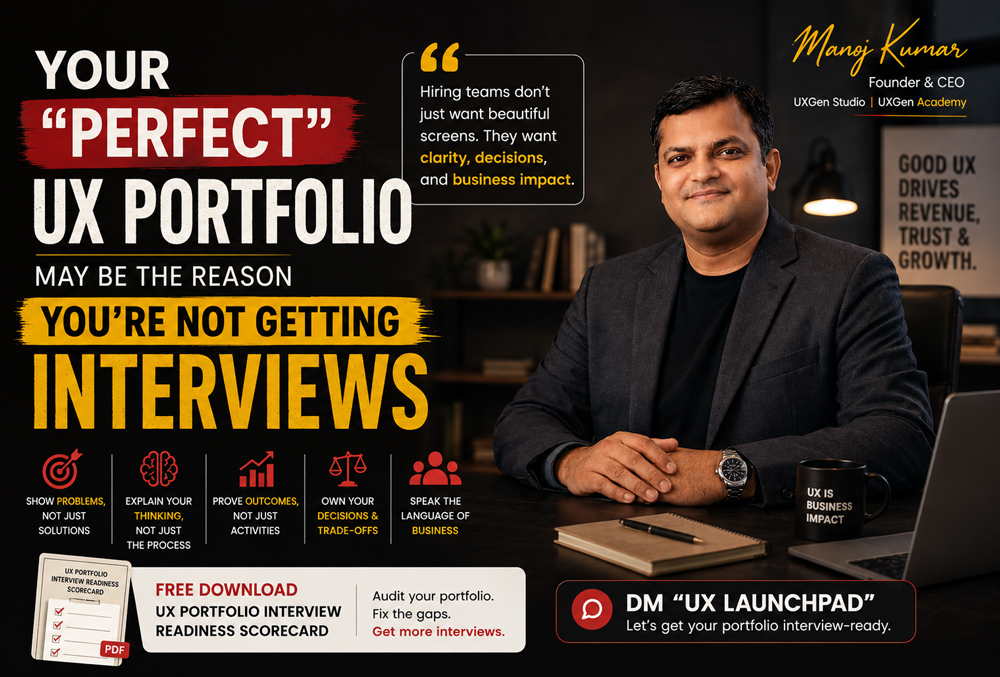
A highly polished UX portfolio can get attention, but it does not automatically earn interviews. Hiring managers are looking for candidates who can diagnose business friction, handle constraints, and measure impact. If you are struggling to land a UX job, the issue is rarely your visual design. The problem is that your case studies lack outcomes and accountability. To fix this, shift your portfolio from a “design process checklist” to a clear narrative showing the business problem, your decision logic, the trade-offs you made, and the final ROI.
The Reality Check Nobody is Giving You
Let me guess. You spent the last three months tweaking shadows, perfecting your typography, and aligning every button on your portfolio website. You created user personas that look like stock models. You polished the UI until it looked premium.
You hit publish, applied to fifty roles, and nothing happened.
While you keep polishing screens, hiring teams are shortlisting candidates who explain problems, decisions, trade-offs, and measurable outcomes. A beautiful portfolio gets attention. A clear portfolio gets interviews.
Over my 25+ years in this industry, I’ve reviewed thousands of portfolios. I’ve hired for enterprise SaaS companies and led major conversion rate optimization initiatives. I can tell you exactly why that perfect portfolio is failing.
You are designing your portfolio for other designers. You are not designing it for hiring teams.
The Missing Part: Your Case Studies Lack Outcomes and Accountability
Most junior and mid-level designers with 6 to 24 months of experience make the same silent mistake. They have beautiful UI screens, good color systems, and neat journey maps. But the story feels incomplete.
Hiring teams do not only want to see what you created. They want to understand why you created it. What business problem did it solve? What decisions did you make? What did you reject?
A perfect-looking case study often becomes dangerous because it hides the messy part of UX. And the messy part-arguing with product managers over scope, dealing with technical constraints, or cutting features to meet a deadline-is where your real skill is visible.
Businesses do not buy design. They buy risk reduction. They buy revenue growth. They buy customer retention. If your portfolio only shows a final, happy path, you look like a decorator.
A UX job is not a decoration role. It is a decision role.
The “Perfect Portfolio” Trap
Many designers are not rejected because their skills are bad. They are rejected because their portfolio gives no evidence of business maturity. A perfect portfolio usually falls into three major traps.
Trap 1: Showing Screens Before Problems If the first thing you show is a final UI, the hiring team has to guess the problem. Do not make them guess. If your case study starts with “I redesigned a food delivery app,” it sounds weak. Instead, say, “The food delivery app had high drop-offs during checkout because users were not confident about extra charges.” That gives context. It shows diagnosis.
Trap 2: Process Without Decision Logic Many portfolios show every process artifact. Research plan, empathy map, wireframe, prototype. But what did you actually learn from each step? If your journey map did not reveal user friction, why should the hiring team care? Process without decision-making is just decoration. You need to explain what constraint changed your direction and why you chose one solution over another.
Trap 3: Zero Accountability This is the biggest issue. And without outcomes, the hiring team cannot measure the seriousness of your work. Outcomes do not always mean big revenue numbers, especially if you are early in your career. Outcomes can be a reduced number of steps, faster task completion, fewer support questions in testing, or improved user confidence. Say what you measured. Say what changed.
The Trade-Off Framework: How to Show Executive Maturity
One of the fastest ways to prove you are ready for a high-level UX job is mastering the art of the trade-off. In the real corporate world, you never have enough time, enough engineering resources, or enough data. If your case study hides this, it looks entirely fake.
Here is a simple, highly skimmable framework to inject business reality into your portfolio: The Constraint-Decision-Impact Model.
- The Constraint: State the limitation clearly. “Engineering could not build the custom date-picker before the Q3 launch due to API limitations.”
- The Decision: Explain how you strategically pivoted. “I reverted to the native OS date-picker. It sacrificed our visual consistency, but it ensured the core functionality worked.”
- The Impact: What was the business result? “This saved two weeks of developer time and allowed us to launch on schedule, capturing $50k in early subscription renewals.”
When you write like this, you prove you are not just pushing pixels. You are an executive partner who understands that shipping a functional, profitable product is infinitely more important than presenting a perfectly cohesive UI on a deadline.
The Portfolio Teardown: Pixel-Pusher vs. Executive Partner
To make this even more actionable, let’s look at a practical example of how you describe your work.
The Weak Version (Rejected): “I redesigned the landing page to make it cleaner and more attractive. I used modern colors, improved spacing, and added better visuals.”
The Strong Version (Interviewed): “The landing page was getting traffic, but users were not moving confidently toward inquiry. The page failed to explain who the course was for and why the mentor was credible. I restructured the page around decision clarity: audience-fit messaging, proof placement, and a stronger CTA path.”
The first sounds like a visual designer. The second sounds like a UX Architect who understands conversion and trust. That is what premium hiring teams notice.
What If You Are an Experienced UX Designer With No Job Offer?
I hear this constantly. People search for reasons behind an “experienced ux no job offer” situation because they feel confused. They have projects. They have real experience. Still, no response.
The reason is not your experience. It is your positioning.
If you have one or two years of experience, your portfolio should not look like a student bootcamp assignment. It must show professional awareness. You need to stop just saying what you designed and start explaining the business problem. Show how user friction affected the product. Add constraints like timeline pressures or technical limits.
Hiring teams want to see whether you can enter a real corporate team and think responsibly. Not perfectly. Responsibly.
Bridging the Gap with UXGen Academy
This exact problem-designers knowing Figma but failing to speak the language of business-is why I founded UXGen Studio and UXGen Academy.
At UXGen Academy, we do not train learners to create portfolios that only look attractive. That is simply not enough anymore. Our approach is entirely career and job-oriented.
As the CTO, Founder, and CEO, I built the AI Driven UX Launchpad alongside Mentor Manoj, who brings over 25 years of specialized experience in UX leadership and hiring. Together, we built this curriculum for learners, career switchers, and junior UX/UI designers who want to move beyond surface-level design.
We don’t just teach tools. Mentor Manoj and I show you how hiring teams actually judge UX maturity, how to structure your case studies like business cases, and how to use AI to accelerate your problem-solving workflow. We help you build real clarity, not fake polish.
Your Next Step
Do not redesign your whole portfolio tonight. Just look at your top case study. Read it out loud. Does it sound like a design gallery, or does it sound like proof of business impact?
If you want me to help you see exactly why your portfolio is not converting into interviews, I have a resource for you.
Download the Free UX Portfolio Interview Readiness Scorecard.
Use this checklist to audit your case studies before you send out your next application. If you can’t prove your outcomes, your portfolio isn’t ready for the executive desk.
Frequently Asked Questions (FAQs)
- Why am I not getting UX job interviews even with a good portfolio?
You are likely not getting interviews because your portfolio looks visually pleasing but does not clearly explain your strategic thinking. Hiring teams want to see the specific problems, your decisions, the trade-offs, and the final outcomes. If your case studies lack outcomes and accountability, it becomes very hard for a manager to evaluate your actual skill.
- What should a junior UX designer include in a portfolio?
Focus on depth over volume. Include 2 to 3 strong case studies with clear problem context, research insights, specific design decisions, trade-offs, and testable outcomes. The goal is not to show every step of the design thinking process, but to show clear, responsible UX thinking.
- Do UX portfolios need measurable outcomes?
Yes. Measurable outcomes make your portfolio much stronger. If you do not have live product metrics or business revenue data, you can still show usability testing results. Highlight a reduction in clicks, improved task clarity, or better form completion rates. Accountability always matters.
- What does “experienced ux no job offer” usually mean?
It usually means the designer has real-world experience but is failing to position that experience correctly. They are applying for mid-level roles but presenting junior-level case studies that focus heavily on final screens rather than business context, cross-functional collaboration, constraints, and ROI.
- What is the biggest UX portfolio mistake?
The biggest mistake is treating the portfolio like a UI gallery. UX is not only about final, polished screens. A strong portfolio acts as a business case: it proves how you understood a complex problem, navigated team constraints, and created a measurable improvement for the user and the company.
- How can UXGen Academy help me improve my UX career?
UXGen Academy helps learners and career switchers build highly practical, job-oriented UX skills. Through the AI Driven UX Launchpad, we combine deep industry experience to teach case study storytelling, research-backed decision-making, and how to connect your daily design work directly to business value and growth.


